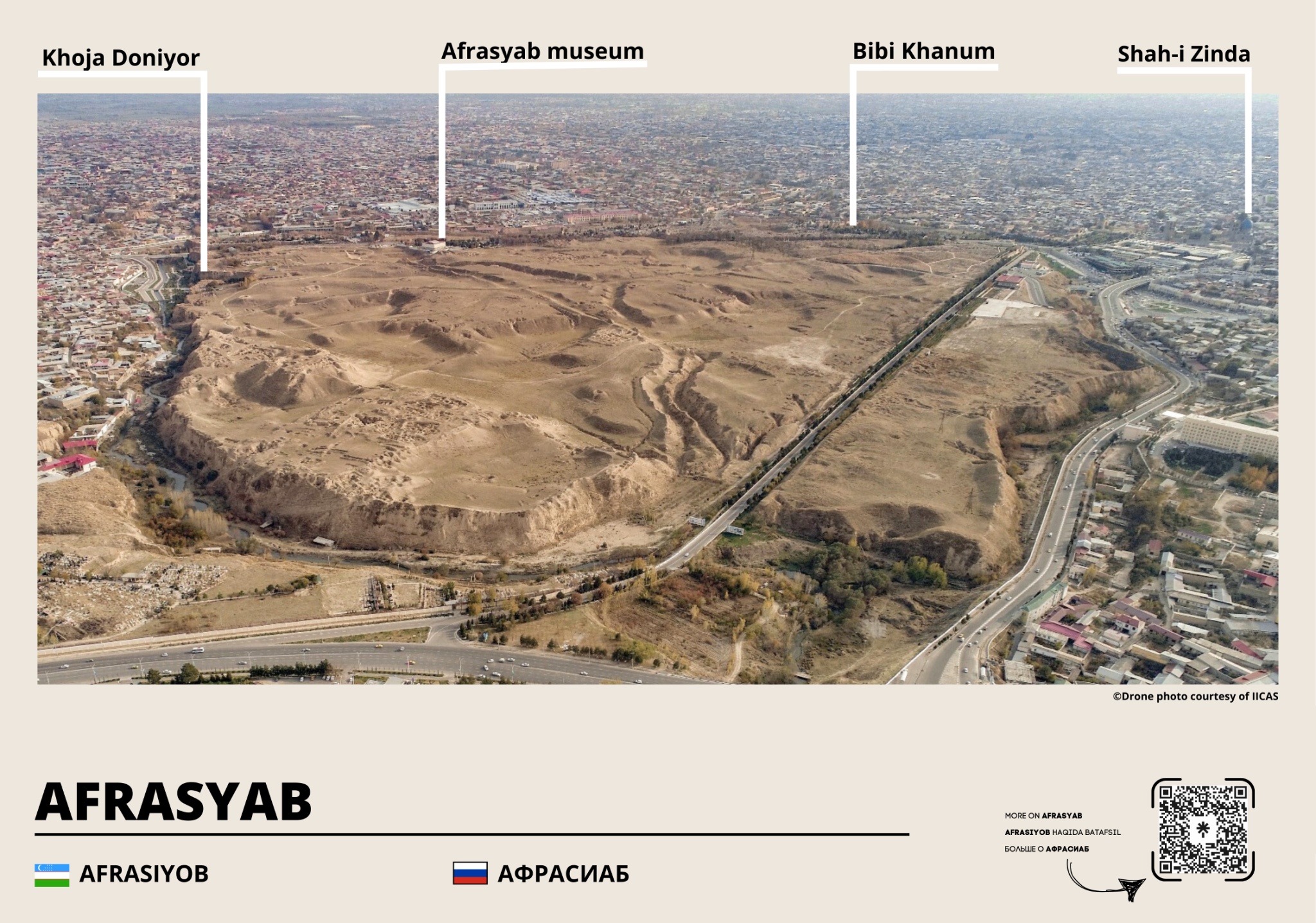
AFRASYAB
The archaeological site of Afrasiab, known as Maracanda in Hellenistic sources, marks the location of the earliest settlement of Samarkand. Founded during the Achaemenid period (6th–4th century BCE), Afrasiab was the political and cultural heart of Sogdiana, a region renowned for its role as a bridge between East and West.
As a thriving urban center along the Silk Roads, Afrasiab became a melting pot of cultures, languages, and religions. Its prosperity peaked during the 6th to 8th centuries CE, when it was adorned with palatial complexes, fortifications, and remarkable murals—such as the famous 7th-century Ambassadors’ Fresco, which offers rare insight into Sogdian diplomacy and cosmopolitan life.
The city remained the capital of Sogdiana until the Arab conquest in 712 CE, which introduced new religious and administrative dynamics while maintaining continuity with earlier traditions.
Afrasiab’s long history came to a dramatic halt in 1220, when it was devastated during the Mongol invasion under Genghis Khan. The site was subsequently abandoned, and the urban nucleus of Samarkand shifted to its current location further south. (© UIAP, negiz xarita: GOOGLE sun’iy yo‘ldosh tasviri, 2023)
Today, Afrasiab stands as a monumental palimpsest—its ruins, tombs, and murals silently testifying to centuries of cultural brilliance, resilience, and transformation.
Uzbek version
Afrasiyob
Afrasiob (yoki ellinistik manbalarida Maroqand) arxeologik yodgorligi Ahmoniylar davrida tashkil topgan. U arablar istilosigacha (milodiy 712-yil) Sug‘diyonaning poytaxti bo‘lgan va Ipak yo‘li bo‘ylab joylashgan yirik markazlardan biri hisoblangan. Bu aholi manzili mo‘g‘ullar bosqinidan so‘ng, 1220-yilda tashlab ketilgan. (© UIAP, negiz xarita: GOOGLE sun’iy yo‘ldosh tasviri, 2023)
Russian version
Афрасиаб
Археологический памятник Афрасиаб (или Мараканда в эллинистических источниках) был основан в эпоху Ахеменидов. Он служил столицей Согдианы до арабского завоевания (в 712 году н.э.) и был важным центром на путях Великого шелкового пути. Поселение было покинуто после монгольского нашествия в 1220 году.
(© UIAP, базовая карта: спутниковое изображение GOOGLE, 2023)
Afrasyab