COMMUNITY
To understand Uzbekistan beyond its monumental architecture or ancient irrigation systems, one must step into the spaces where daily life unfolds — the courtyards, neighbourhoods, and village pathways where relationships are forged and traditions carried forward. If the waterscape reveals how communities have learned to live with and from water, and the heritagescape traces the material and intangible legacies of the past, the communityscape illuminates the living social fabric that binds these dimensions together. It is here, in the realm of people and practice, that the country’s cultural landscapes become most tangible.
At the heart of this social world lies the mahalla, a long-standing neighbourhood institution that continues to shape how communities organise themselves. More than an administrative unit, the mahalla is a source of identity and mutual care — a place where hospitality is a social principle, where elders transmit knowledge, and where collective responsibility guides the rhythms of everyday life. From seasonal celebrations to the upkeep of small irrigation channels, from resolving family matters to organising communal work, the mahalla reveals a society in which cooperation is as essential as heritage or water.
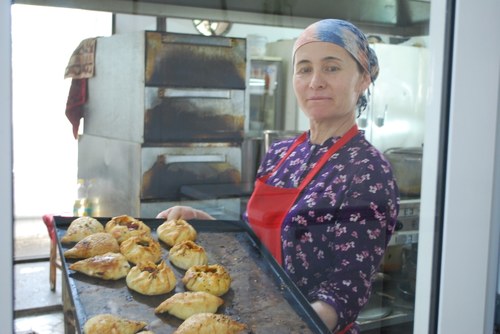
Travelling along the itineraries proposed on this platform — from the fertile outskirts of Samarkand to villages near archaeological sites such as Kafir Kala — visitors encounter communities whose daily practices offer insight into how tradition and modernity coexist. In these areas, agriculture, craftsmanship, and domestic life remain intertwined. Baking bread in outdoor ovens, weaving textiles, preparing plov, or tending gardens are not simply chores: they are acts of continuity, repositories of memory, and opportunities for intergenerational learning.
Encounters with local residents often unfold spontaneously. A shared pot of tea, a courtyard conversation, or an invitation to join a family meal becomes a window into the values that define social life. Importantly, this hospitality is not a performance staged for visitors — it is a deeply rooted ethic, extended naturally to newcomers. For many travellers, these interactions become as formative as visiting monumental sites or exploring archaeological remains.
The communityscape also highlights how Uzbek communities are responding to contemporary transformations — from shifts in agricultural systems to new economic opportunities driven by mobility and tourism. Rather than losing cohesion, many neighbourhoods and villages are creatively adapting. Some have developed community-based tourism initiatives that allow residents to share their skills in weaving, cooking, or farming, while generating supplementary income and strengthening local pride. Others experiment with new forms of collective organisation, drawing on the mahalla’s longstanding spirit while navigating the realities of the present.
Seeing Uzbekistan through its communities means recognising that landscapes — whether natural, agricultural, or urban — are always inhabited, interpreted, and cared for by people. The valleys of the Zeravshan, the outskirts of Samarkand, and the rural settlements embedded in these itineraries are not static backdrops. They are living environments shaped daily by negotiation, memory, resilience, and aspiration.
In conversation with the waterscape and the heritagescape, the communityscape invites visitors and scholars alike to explore Uzbekistan as a dynamic intersection of ecology, history, and society. It offers a chance to understand how people sustain their traditions, reimagine their futures, and welcome others into their world — revealing a country where community is not merely a social structure but a way of experiencing and giving meaning to place.


