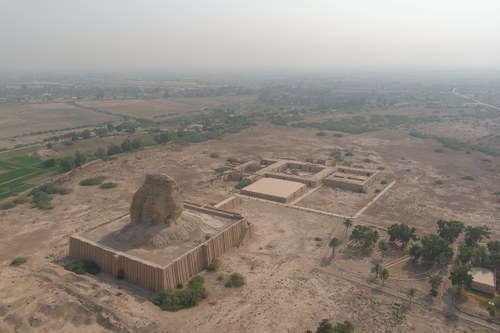
AQAR QUF (DUR-KURIGALZU)
In 2025, between January 9th and January 30th, an intensive survey was carried out at the archaeological site of Aqar Quf (ancient Dur-Kurigalzu), located in the western hinterland of Baghdad. This mission was conducted by a team of six archaeologists from the University of Bologna (UNIBO), in collaboration with two heritage operators from the Iraqi State Board of Antiquities and Heritage (SBAH).
The fieldwork followed a systematic methodology, organized along longitudinal transects, designed to ensure complete coverage of the site and its surrounding areas of archaeological interest. Data collection was carried out using QField, a mobile application integrated with QGIS, which allowed for real-time synchronization of geospatial and descriptive data with the main GIS platform.
This intensive survey marked the third field reconnaissance campaign in the archaeological area of Aqar Quf. The primary focus of this season was the northwestern sector of the ancient city, particularly the area of Tell Ahmar. In total, 198 grid squares, each measuring 100 x 100 meters, were surveyed. The data revealed consistent evidence of damage in this sector, primarily due to recent human activities such as the construction of new houses, the excavation of water canals, and the intensification of agricultural exploitation.
The results of this campaign have made a significant contribution to the reconstruction of the ancient city’s original urban layout and spatial extent. These results are crucial in developing informed strategies for the long-term protection and management of the archaeological area, ensuring the enhancement and preservation of Aqar Quf’s cultural heritage for future generations.
On October 12th and 13th, a two-days in-person training session was held at the Iraq Museum by the UNIBO team to strengthen and improve the skills of SBAH personnel in the conservation of clay tablets. The training, led by an Italian art conservation expert, Ms. Nadia Barbi, was attended by 14 SBAH employees and focused on various techniques for the preservation of archaeological tablets. The first day was dedicated to theoretical topics, including the role of the conservator and the responsibilities of cultural heritage professionals in safeguarding Iraqi cultural heritage. The second day, on the other hand, was more practical and centered on the hands-on practical application of minimally invasive conservation techniques on sample tablets.
Two additional training sessions were carried out at the archaeological sites involved in the project: Aqar Quf, Ishchali and Tell Muhammad, both located in Baghdad. These activities focused on architectural conservation techniques and were delivered by expert architects and conservators. At Aqar Quf and Ishchali, the UNIBO team, led by Prof. Marchetti demonstrated the most suitable methods for structural repairs of mudbrick architecture, with particular attention to the correct placement of mudbricks to prevent further deterioration of archaeological structures.
At Tell Muhammad, the UNICT team, led by Prof. Laneri, provided a training on material decay and deterioration, architectural restoration methods, including the preparation and drying processes of mudbricks. These two trainings was attended by the SBAH personnel of the Archaeological Conservation Department and in both cases, part of the training was also dedicated to sustainability and raising awareness on conservation practices, in line with the project’s objectives.
