Canada
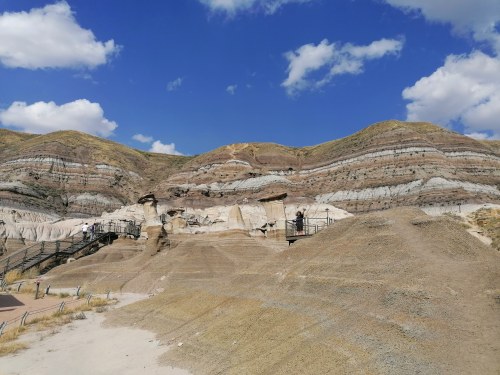
Cretaceous ecosystems in Alberta: a natural laboratory for understanding Earth’s past
At the end of the Cretaceous Period, between 75 and 66 million years ago, western North America hosted some of the richest and most diverse communities of dinosaurs and other terrestrial vertebrates ever to have existed. This exceptional abundance of fossils makes the area one of the best natural laboratories in the world for studying how animal communities change over time, how different environments (coastal settings, the continental interior, more northern or southern regions) influence biodiversity, and how ecosystems respond to large-scale environmental, climatic and geological transformations. Our research group works primarily in Alberta (Canada), a key region for reconstructing these scenarios.
What we study: fossils, environments and change through time
The fossil faunas of Alberta allow us to tackle major evolutionary questions (macroevolution), linked to so‑called biogeographical provincialism. We aim to understand, for example, how much faunas change when moving from south to north, and whether there were genuine “faunal provinces”, each with its own characteristic species. We also investigate whether animals living near the sea differed from those inhabiting more inland areas of the continent, and how communities changed when moving from coastal environments to floodplains and forests far from the shoreline. To address these questions, we do far more than simply list dinosaur species: we relate the fossils to the ancient environments in which they formed.
In Alberta, our work focuses mainly on three major Late Cretaceous geological units: the Belly River Group, the Edmonton Group and the Wapiti Formation. These rock successions form an extraordinary archive of the past, because they combine an exceptionally rich fossil record with a very detailed record of environmental change through time. Within these rocks we find a great variety of terrestrial vertebrates: herbivorous and carnivorous dinosaurs, turtles, crocodiles, lizards and numerous small vertebrates, including early mammals, amphibians and freshwater fish. This is not just an impressive collection of species, but a genuine mosaic of communities that allows us to reconstruct how terrestrial ecosystems were organised at different times during the Cretaceous.
These units are also important because they record, with very few interruptions, the alternation of different environments. Layer by layer, the rocks reveal the transition from phases when the region was occupied by an inland sea, which deposited marine sediments, to periods dominated by rivers, floodplains, lagoons, swamps and forests. This continuity enables us to follow the evolution of the landscape and to understand how life on land responded to these changes. To make the most of this information, our team carries out fieldwork in different parts of Alberta, with the aim of understanding how local and global environmental changes are reflected in the fossil record. We do this by integrating several approaches. From a taphonomic perspective, we analyse how organisms died, how their bones accumulated, whether they were moved by water or damaged by predators and physical processes. This helps us to distinguish whether a site preserves the remains of a community that lived in a particular environment, or whether it represents a mixture of transported and reworked remains, and to identify the conditions that promoted preservation, such as sudden floods or rapid burial.
Through sedimentological studies we examine the types of sediments and their structures in order to reconstruct the depositional environments: braided or meandering river systems, deltas and coastal plains, lagoons, swamps, tidal flats and deeper marine settings. Each depositional context provides the essential framework for correctly interpreting the associated fossil communities.
Using stratigraphy and chronostratigraphy, we reconstruct the order in which the layers formed and date, as precisely as possible, the events recorded in the rocks. This is crucial for determining which faunas were truly contemporaneous and which belonged to different time intervals, for tracking the appearance, spread and disappearance of species, and for linking changes in faunas to specific geological or climatic events. Taken together, these studies allow us to build a unique database on the environmental, climatic and ecological dynamics of the Late Cretaceous in this part of the world, while at the same time providing an ideal training and research ground for those wishing to engage with palaeontology and the geosciences.
This research is grounded in a long-lasting collaboration between scientific partners and with all necessary authorizations from the Province of Alberta. Active research activities involve the University of Alberta (Edmonton, Ab), Philip J. Currie Dinosaur Museum (Wembley, Ab), Northwestern Polytecnic (Grande Prairie, Ab), Royal Tyrrell Museum (Drumheller, Ab) and Royal Ontario Museum (Toronto, ON).


