Mongolia
There ain't such animal - Gobi Desert, 1965
Vast Nemegt
Since their discovery in 1923 by the iconic explorer Roy Chapman Andrews – often cited as an inspiration for Indiana Jones – the dinosaurs of the Gobi Desert in Mongolia have offered one of the most complete pictures of life at the end of the Mesozoic. The historic expeditions of the American Museum of Natural History uncovered some of the first known dinosaur nests, with eggs and skeletons preserved together, profoundly changing our understanding of dinosaur biology and behaviour.
Over the past 25 years, new excavation campaigns in southern Mongolia have brought to light dozens of exceptionally well-preserved skeletons, often complete and articulated, sometimes in poses that directly document behaviours such as brooding or predation. The famous successions of the Nemegt Formation and related units are now among the best “natural laboratories” for studying continental ecosystems shortly before the end-Cretaceous extinction.
However, this very richness of material has fuelled an intense illegal trade in fossils. Skeletons of Mongolian dinosaurs have repeatedly appeared on the black market and at international auctions, often with vague or fabricated provenance. With the start of complex repatriation processes for many of these specimens, the question “where exactly do they come from?” has become crucial, both for legally recognising their origin and for restoring a scientifically meaningful context to those fossils.
Our work in the Gobi is based on a long-standing collaboration with the Institute of Palaeontology and Geology of the Mongolian Academy of Sciences. In 2023 we signed a five-year agreement to develop the Nemegt Educational Expeditions project, which promotes geological, palaeontological and mapping research in the Ömnögovi province, with a strong training component for Mongolian and international students and early-career researchers.
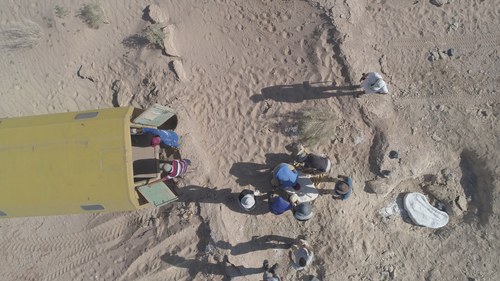
The project tackles two main challenges: improving scientific knowledge of Late Cretaceous ecosystems in Mongolia and providing concrete tools to combat fossil poaching. Using drones, digital technologies and over 90 years of field experience, we are producing high-resolution maps that integrate geological and palaeontological data, documenting in detail outcrops, fossil-bearing levels and rock units. These maps allow an unprecedented assessment of the ecosystem and help to plan future field campaigns more efficiently.
In parallel, we are developing tools based on geochemical “fingerprints” of fossil-bearing rocks. By analysing the chemical and isotopic composition of the strata, we are building a database of geochemical signatures that can, in many cases, link fossils lacking contextual data – including specimens repatriated after illegal trafficking – to specific geological units or areas of the Gobi. This approach, already recognised internationally, will be extended in particular to two of the sites most affected by poaching, with the aim of creating a model that can be applied to other global hotspots of the illegal fossil trade.
For students and colleagues, the Nemegt Educational Expeditions project offers the opportunity to take part directly in field research, contribute to the protection of a unique heritage, and train in a setting that combines palaeontology, geology, digital technologies and genuinely “forensic” methods applied to fossils.


