New Publication on EU Regulatory Industrial Policy and the Green Transition
Exploring how regulation shapes industrial transformation in the European Union
Published on 25 March 2026 | News
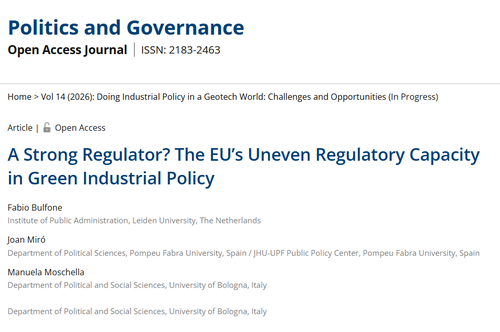
A new article co-authored by Manuela Moschella, Professor of Political Science at the University of Bologna and Director of EUFutures, together with Fabio Bulfone and Joan Miró, examines how the European Union uses regulation as a key instrument of industrial policy in the context of the Green Deal and increasing geopolitical competition.
Published in Politics and Governance, the article, “A Strong Regulator? The EU’s Uneven Regulatory Capacity in Green Industrial Policy,” the paper examines regulation as a key instrument through which the EU seeks to promote industrial transformation. The authors conceptualize regulatory industrial policy as operating through three channels—structuring markets, shaping production processes, and directing financial flows—and develop a framework to explain variation in the European Commission’s regulatory capacity.
Moving beyond accounts that emphasize legal authority and expertise, they argue that regulatory outcomes are shaped by two critical political factors: the cohesiveness of corporate actors and the salience of policy issues. Empirically, they illustrate this framework through three flagship initiatives of the European Green Deal: the EU taxonomy for sustainable activities, the revision of CO₂ emission standards for vehicles, and the Carbon Border Adjustment Mechanism.
Together, these cases demonstrate how business cohesion and politicization condition the Commission’s regulatory capacity. More broadly, our findings challenge the view that regulation and industrial policy are antithetical. Instead, they show that regulation can serve as a core industrial policy instrument, steering markets and reshaping economic structures in ways traditionally associated with direct state intervention.