


Date:
Event location: Center for Interdisciplinary Studies, University of Sarajevo, Bosnia and Herzegovina
Type: TheGAME events

The fifth workshop of the TheGAME ERC brought together core team members, with members of the ethics board, advisory board, research associates, and the Serbian NGO klikAktiv in Sarajevo, Bosnia and Herzegovina, from May 20-21. Over two days, at the Centre for Interdisciplinary Studies of the University of Sarajevo, the group presented research and reflected on one of the central, ubiquitous, but somewhat controversial, concepts of both the Balkan Route and the project, “the Game.”
The first session focused broadly on “Conceptualizing the Game”—not aiming for a singular definition, but theorizing from the grounded contexts of their research. The presentations began with “Conceptualizing the Endgame” of the Balkan Route, as Claudio Minca, Dragan Umek, and Shahid Aziz presented together on their ongoing research in Trieste—a key location from which to reflect on the route as a whole, and the ways in which characteristics of the Game spill-over beyond its “end”. Roberta Gentili then presented on “Infrastructures of Mobility in Una Sana Canton,” with attention to temporalities of the game that extend beyond periods of border crossing at the Bosnian-Croatian border. Sebastian Cobarrubias’ presentation, “Walking the map? Reflections on countermapping and critical cartographies of the Balkan Route or The Game, my phone, countermaps, and why should I care?!” reflected on uses of the term “counter-mapping,” and what it might mean from the grounded context of migrant mapping practices as infrastructural to the game and the route.
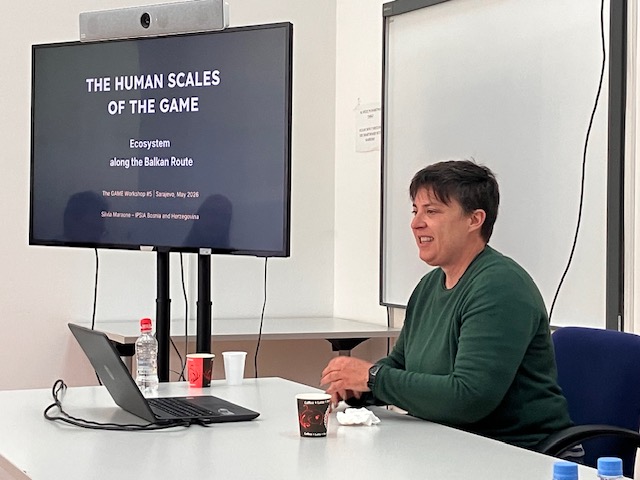
The second session, “Scales of the Game” brought together presentations from research and practice, with attention to local and international actors within the route. Viki Mladenova theorized the Game as a “vital force of the Route” which does not only apply to recent and ongoing migrant trajectories, but which also encompasses longer histories of informality, mobility, and diasporic and border-crossing modes of life across the region. Francesco Marchi then shifted attention to a different “set” of actors, drawing on critical analysis of the published diaries of Italians who travelled to/through the Balkans as solidarity activists in his presentation, “The(ir) Game: the predicament of postcolonial solidarity.” Rounding out the session, and drawing on years of experience as a practitioner in the region, Sylvia Maraone’s presentation on “The Human Scales of the Game: The Ecosystem along the Balkan Route” critically considered the interactions of multiple actors at different scales.
The final session of the first day addressed “Institutional Infrastructures of Migration and the Game.” Lorenzo Vianelli discussed “accession games” and the multi-scalar plurality of “games” in his presentation, “Who Plays the Game? Geopolitics, Enlargement, and Border Externalization along the Balkan Route.” Yolanda Weima presented research conducted in Sarajevo, on the relationship between camps and the route, including people’s experiences of “games” in Southern Balkan countries prior to their arrival in Bosnia. Elisa Pascucci’s presentation posed the provocative questions, “How can we think about the Balkan route and the Game through the category of failure?” and “What does Failure do in this governance landscape?” among others, and reflected on the folds of life-making that persist in the “landscape of failed otherness,” prompting lively discussion to wrap-up the academic program of the first day.
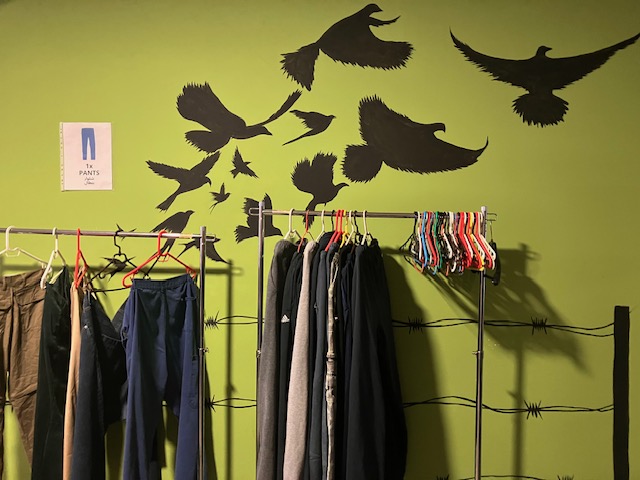
The following day began with a “field visit.” Our first brief stop was the bus and train station, just behind the University of Sarajevo, where we discussed the changing visibility and presence of people-on-the-move in the city, and initial and long-term response from local residents. We then walked up to Kompas 071, a Bosnian organization that has been active for many year supporting people-on-the-move through a drop-in day centre in Sarajevo. In addition to visiting their vibrant space, we learned from their staff about various factors shaping the rhythms of their work in relation to the dynamic mobilities of “the Game.”
We returned to the University of Sarajevo for our fourth session, “Game geographies: Borders, fences, and makeshift camps.” Milica Švabić, Dragan Umek, and Claudio Minca presented on their research in Serbia over the past decade, with particular attention to the geographies of makeshift and institutional camps in the game. Emma Beatrice Farina reflected on the game as an archeological landscape, sharing results from her PhD research, with particular analysis of graffiti in makeshift camps, and the ways in which they attach meaning to place and even reflect on migration journeys. Alexandra Rijke presented on border walls within the Route, with a particular emphasis on her original research with local communities living near a border wall in Serbia.
The final session of the day brought to the fore a theme that had been present in many prior sessions, “Moving on: Agency and the Game.” While Lucija Klun was unable to attend in-person, her research on migrants’ experiences of both “feeling forced” and “feeling forceful” in the “walk-game” was presented on her behalf by Claudio. Vasiliki Makrygianni concluded the academic presentations with a careful consideration of the dialectical, spatial, application of “game-theory” and theories of “gamification” and “play” to the spaces of the Balkan Route, with particular reference to her work in the under-researched Eastern Aegean Border Archipelego (the so-called “Greek Islands”).
In the concluding commentary, Elisa Pascucci was invited to imagine, discuss, contest, and even resist the ideas presented over the two-day workshop. Her elegant discussion began by considering the ambiguous and expansive spatialities and temporalities of “the game,” and noted the importance of considering race and racialization, as well as researching the Balkans themselves as part of researching the Route. Among other themes, she reflected on the materialities and embodied geographies of the Game evident in both the presentations and the visit to Kompas 071. Finally, she returned to the provocation to consider what failure does within the route at diverse spatial and temporal scales, prompting a lively discussion considering the directions of diverse and original scholarship within the ERC project TheGAME.



Center for Interdisciplinary Studies, University of Sarajevo