Astroparticle theory
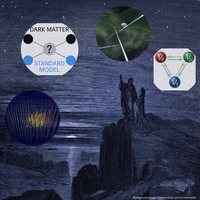
Why do neutrinos have mass? How do they oscillate? What is dark matter? Why is there so much more matter than antimatter in the Universe? What is the origin of masses and of the approximate fundamental symmetries? How did our Universe evolve to what we observe today? These are the key questions that motivate our research activity in the theory and phenomenology of astroparticle physics.
We build theoretical models that address the questions above, opening a new window on the physics beyond the Standard Model and the evolution of the Universe. The approach of our group is driven by the necessity to test these ideas with measurements at a variety of particle and astroparticle experiments, as well as with cosmological and astrophysical observations, including neutrino and dark matter detectors, particle accelerators and telescopes. We also investigate novel ways to test these models. Examples include gravitational waves from early-universe phase transitions, new techniques to look for dark matter via its effects in large neutrino detectors, non-standard signals of rich dark sectors like semi-visible decays, global fits of neutrino oscillation data in standard and non-standard scenarios. We also develop and maintain public scientific software that the research community can freely employ.
Faculty members: Xabier Marcano Imaz, Michele Lucente, Silvia Pascoli, Filippo Sala.
Neutrino theory and phenomenology
The discovery of neutrino oscillations in 1998 implies that neutrinos have mass and mix, contrary to the predictions of the Standard Model. A precise picture of neutrino properties have been provided by a wealth of experiments. Some open questions remain, namely the value of neutrino masses, the violation of the CP symmetry in the leptonic sector, the precise values of the mixing parameters and the test of the standard 3-neutrino paradigm. The questions are crucial to understand the origin of neutrino masses and mixing in extensions of the Standard Model.
We study neutrino properties assessing the physics reach of current and future experiments in their determination, with emphasis on short, e.g. MicroBooNE, and long, e.g. DUNE, baseline neutrino oscillation experiments and neutrino less double beta decay, and we exploit the neutrino portal to hunt for hidden sectors. On the theoretical side, the origin of neutrino masses calls for a new energy scale: our approach is to consider the broadest range going from low scale see-saw models to the GUT scale and to identify the phenomenological signatures of such models, e.g. leptogenesis, GeV-scale heavy neutral leptons. From an astroparticle physics perspective, we exploit the key role neutrinos had in the evolution of the Universe to pin down their properties, in particular the precise measurement of neutrino masses, and their possible connection to dark matter.
Baryon asymmetry
The universe is observed to contain way more matter than antimatter. This matter-antimatter, or baryon, asymmetry is not explained by our current understanding of the fundamental laws of nature. We work on building new models that explain the observed baryon asymmetry of the universe, with the aims to open new ways to observationally test the origin of matter (e.g. with gravitational waves and with high-intensity and high-energy colliders) and/or to open new connections with other BSM avenues like neutrino masses, dark matter and supersymmetry. We also work on signatures of models of baryogenesis and leptogenesis at neutrino detectors and at various accelerator facilities.
Dark matter searches and models
We know dark matter (DM) exists and makes up 85% of the matter in the universe, but we do not know what it is made of. Its identification is a primary goal of modern science. We work on novel signals of various DM models, for example on the detection at DM and neutrino experiments of the high-energy DM fluxes that necessarily exist, induced e.g. by cosmic-ray upscatterings or by atmospheric showers. Our work on DM signals includes, in addition, those in cosmic rays and in photons and neutrinos from the sky, in cosmological observables, and at high-intensity and high-energy accelerator facilities. We also work on DM models and production mechanisms that offer new ways to test DM, for example with gravitational waves when the DM origin is related to a phase transition in the early universe, and/or that offer new connections with other open problems of our understanding of nature, like neutrino masses, the baryon asymmetry, the hierarchy and flavor problems.