Ionising radiation risk
What is this?
Ionising radiation exposure
Ionising radiation risk occurs when people engaging in work, study or research, as well as the general population, are exposed to ionising radiation (IR).
At the University, the ionising radiation you may come into contact with is mainly produced by:
- Radioactive nuclides (e.g. sources of phosphorus-32, cobalt-60, caesium-137, strontium-90, AmBe);
- RX tubes (X-rays) or accelerators (electrons, X-rays).
All ionising radiation is classified by the International Agency for Research on Cancer (IARC) in Group 1 – Carcinogenic to humans.
Applicable regulations
The risks arising from using ionising radiation sources are regulated by Legislative Decree 101/20, as amended.
This Decree provides the regulatory basis for assessing, establishing, defining and monitoring rules for using ionising radiation sources safely and for managing radiation protection of those exposed to this particular type of risk.
Where can occur?
Activities and environments at risk of ionising radiation
A number of human activities and applications use artificial ionising radiation directly or indirectly.
The most significant ones include medicine, energy production, scientific and technological research, industry in general, agriculture and the food sector, geology and mining, as well as environmental applications.
Ionising radiation environments can be grouped into two large families:
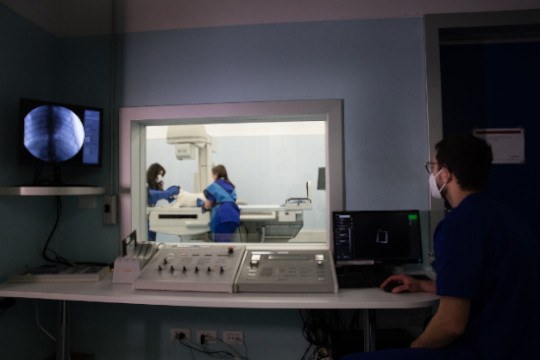
- Rooms where x-ray equipment is installed (for example, veterinary x-ray rooms, dental clinics, x-ray bunkers);
- Rooms where radiation sources are installed and handled (for example, biochemistry laboratories or detector calibration laboratories).
Assessment
Risk estimate and emergency plan
In order to estimate ionising radiation risk, Radiation Protection Experts carry out an assessment strictly in accordance with the guidelines of national and international bodies, also by means of dedicated software.
Using ionising radiation sources requires an environmental impact assessment at all times (production of radioactive waste or releases into the atmosphere).
An emergency plan is only provided in special cases. The assessment covers relations with fire, earthquake, flooding, etc. risk and the possible impact on workers and the general population.
Get in touch with the Medical Physics experts for an assessment (DA CORREGGERE)
Radiation protection
Instructions for staff at risk
Anyone who works with or is exposed to ionising radiation is subject to Health surveillance in the event of exposure to ionising radiation. (LINK IN ITALIANO)
For this reason, it is essential to provide your personal details to the Medical Physics Centre via the radiation protection data sheets:
For medical specialty students (MFS)
(ALLEGATI IN ITALIANO)
Safety instructions and procedures for structures and departments
Depending on the source that you intend to use, the safety instructions and procedures must be adapted accordingly.
At every University location where ionising radiation sources are present, the following is implemented:
- An initial site design indicating the specific protective physical barriers and/or special construction rules for the room where activities will be carried out;
- A preventive specific risk assessment setting out instructions (operational radiation protection and emergency rules) and any protective equipment to be used;
- A notification to and/or licence from the authority in charge of the activity;
- A Radiation Protection Register collecting all notifications in connection with the activity;
- An individualised assessment for each worker licensed to use the source;
- A regular radiation protection check.
Before installing new radiological equipment or changing existing one, each Department must see the (attached) Operational Radiation Protection Book for all legal and safety procedures to be implemented.
Get in touch with Medical Physics before each intervention to agree on the procedure.