Sustainable Transport Modes and Urban Regeneration Impact
bicycle performance monitoring, bike simulator studies
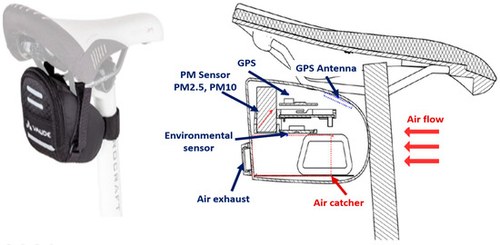
Our Sustainable Transport Mode and Urban Regeneration Impact research explores how active mobility and low‑emission transport modes contribute to healthier and more resilient urban environments. A central study within this theme integrates low‑cost environmental sensors onto bikes to monitor fine particulate matter (PM2.5 and PM10) . Through extensive calibration and data collection, this work maps riders’ exposure to air pollution , demonstrating how sensor‑enabled cycling can reveal environmental patterns and inform route planning to minimize exposure. In related work, we conduct bicycle performance monitoring on protected cycle lanes to examine how infrastructure variations influence cyclist behaviour, speed, and visual attention. Using instrumented bicycles, GPS, and eye‑tracking data, this research assesses the effects of different separation elements and design features on both objective performance metrics and perceived safety. Findings from these experiments are directly relevant to planning cycle infrastructure that supports comfort, safety, and modal shift. Additional initiatives such as CRAFT (G.A. 101056946), REVALUE (G.A. 101096943), and our interactive bike simulator studies integrate cycling behaviour analysis with urban regeneration goals, linking active transport performance with broader sustainability objectives