On your own, Help needed
Learn how to safely and effectively contain an animal

The puppets act as stage objects in a role-play aimed to memorise the sequence of movements, the type of grips and the positions the animal should assume during the various restraints.
They are not intended to simulate additional difficulties such as weight, size or nature of the animal, which are addressed in other teaching contexts on the live patient. The use of manikins also allows repeated practice without stressing a real animal.
sternal station or lateral recumbency

Before moving or restraining an animal, it is important to approach it from the side, not the front. Always be aware of the rules for your own safety and for the safety of the patient.

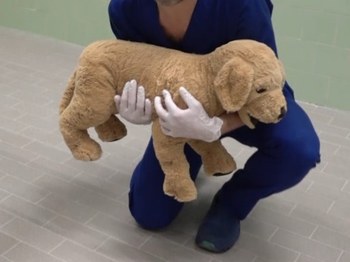
To lift a dog onto an examination table, put your left arm around the dog's neck (without compressing it) to control its head movements and your right arm under the dog's abdomen, near the hind limbs.
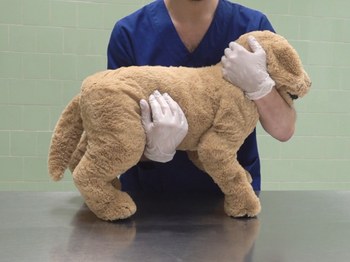
Position the patient on the examination table. Hold the patient's body close to your chest to ensure proper restraint.

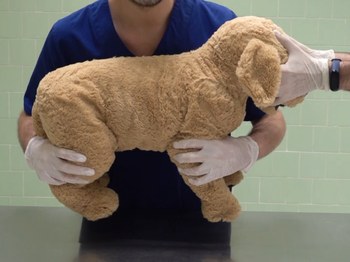
To support a dog in a lateral recumbency, grasp the forelimbs with your left hand and the hindlimbs with your right hand and position on the side on which you want the patient to lie (holding the head to prevent it from hitting the table). While supporting the dog's body against your body, swiftly and gently pull the legs away from you. Lower the dog to the table, while continuing to support the dog’s body against your body.
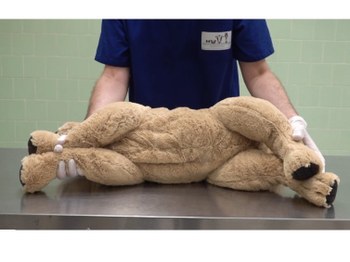
Once lateral recumbency has been achieved, the forelimbs and hindlimbs should be extended and held with each hand with three fingers (middle, ring and little finger) caudal to the limb resting on the table, the thumb over the contralateral limb and the index finger between the two limbs.

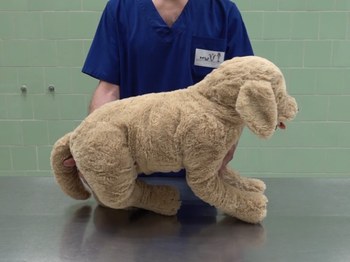
To get the dog into the sternal position, keep the left arm around the neck and pass the right arm behind the knee area. Apply gentle downwards pressure to make the dog sit.
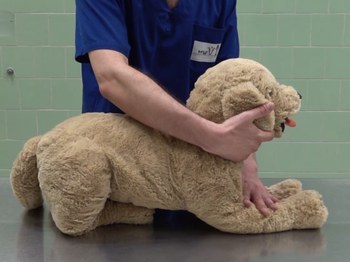
Then, using the right arm, gently push the hindlimbs forward, applying slight downward pressure on the patient's lumbar region until a sternal position is reached.
From cephalic, saphenous or jugular vein

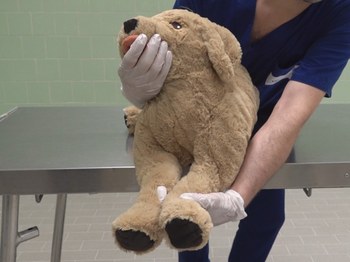
To take a blood sample from the jugular vein, place the dog in sternal recumbency (see above) and remove the collar.
With the right hand, turn the patient's face slightly upwards and contralateral to the side of the neck from which the sample is to be taken. Hold the dog's snout firmly with the right hand and its forelimbs with the left hand and apply light pressure to the patient's lumbar region from top to bottom.

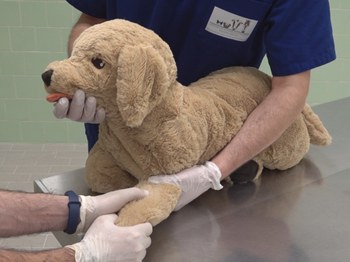
To take a blood sample from the cephalic vein, have the dog assume the sternal recumbency (see above).
Using the right hand, hold the dog's neck firmly with the right forearm and the selected forelimb with the left hand. (da controllare questa frase nella parte italiana)
The left hand will be placed caudal to the elbow region, so as to prevent retraction of the limb by the dog. In addition, gentle pressure of the thumb will facilitate better identification of the vein from which the blood sample is to be taken.

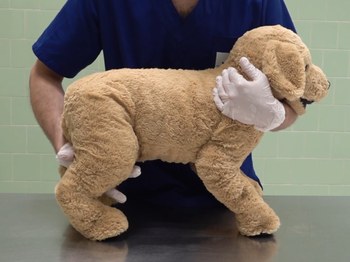
To take a blood sample from the lateral saphenous vein, put the dog in a standing position (see above).
Then, with the left arm around the patient's neck, apply gentle pressure with the right hand behind the knee to facilitate identification of the vein to be sampled.
Alternatively, the same manual technique can be used with the patient in a lateral recumbency.

First of all, remember that muzzles come in different sizes and that each muzzle can be adjusted in length by means of holes in the strap, which is placed at the back of the dog's head, approximately at the level of the occipital bone.
Ensure that you and anyone handling the dog are in a safe condition. If necessary, call for additional assistance. While waiting for the muzzle to be applied, ensure that the dog is aware of your presence.

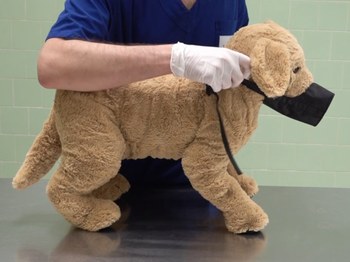
With the help of a colleague, restrain the dog and approach it from behind (so that it does not see you coming). Slide the muzzle over the dog's nose, ensuring a perfect fit.
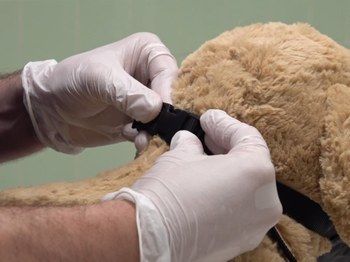
Using both hands, secure the muzzle behind the dog's head at the level of the occipital bone.

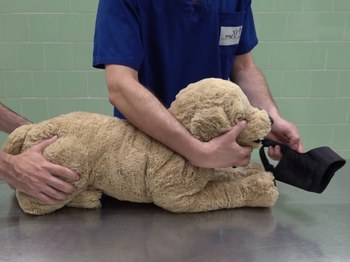
Once the dog is in this position on the examination table, continue to support the patient's neck with your arm and hold the muzzle with your other hand.
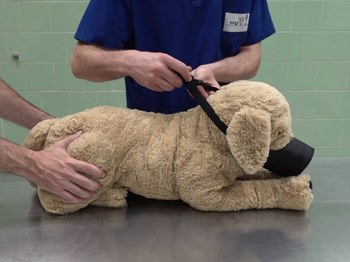
With a swift movement of your right hand, bring the muzzle in front of the dog's nose and slide it back until it fits perfectly. Then fasten it as described in the quadrupedal approach (see above).
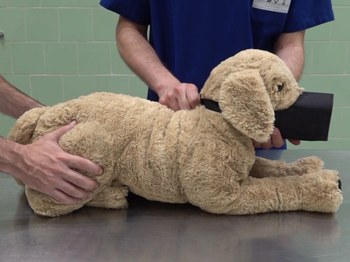
Hold the dog's neck firmly to prevent it from removing the newly placed muzzle.

To remove the muzzle after completing the necessary procedure or handling, untangle the two ends of the buckle (connected by a clasp or metal hook inserted into a hole in the buckle) and remove it. If a dog is aggressive, it may be advisable to undo the buckle and let the muzzle fall off the dog's muzzle afterwards.

It is important to note that harnesses come in various sizes and that many models allow for adjustable strap lengths.
If you want to apply the harness with the patient in quadrupedal station, ensure that you and anyone handling the dog are in a safe condition. If needed, request additional assistance. Before applying the harness, make sure that the dog is aware of your presence.

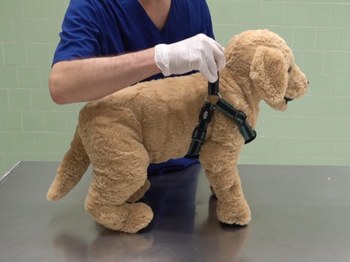
With the dog restrained by a colleague, pass the paw part of the harness under the patient's front limbs. Lift the harness until it makes contact with the dog's chest.
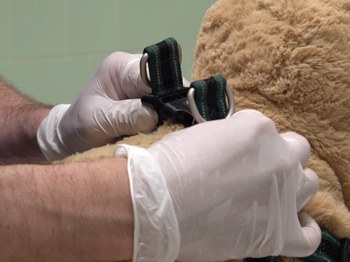
Using both hands, fasten the harness around the dog's dorsal region, just above the neck. Ensure that the harness is secure and comfortable for the dog.

When you want to remove the harness, simply untangle the two ends used to fasten it (connected by a snap fastener) and pull the harness off the dog's front limbs. If a dog is aggressive, it may be advisable to simply unfasten the straps and let the harness slide off the dog's chest afterwards.

Authored by: Dr. Giovanni Romito
Editing: Linda Paoletti & Dr. Marco Canova
Translation: Giulia Micaletto
Please tidy up, before you leave!
Remove the muzzle and the harness from the model.
Put all used muzzles and harnesses to their respective boxes.
Please leave the station as you'd wish to find it!