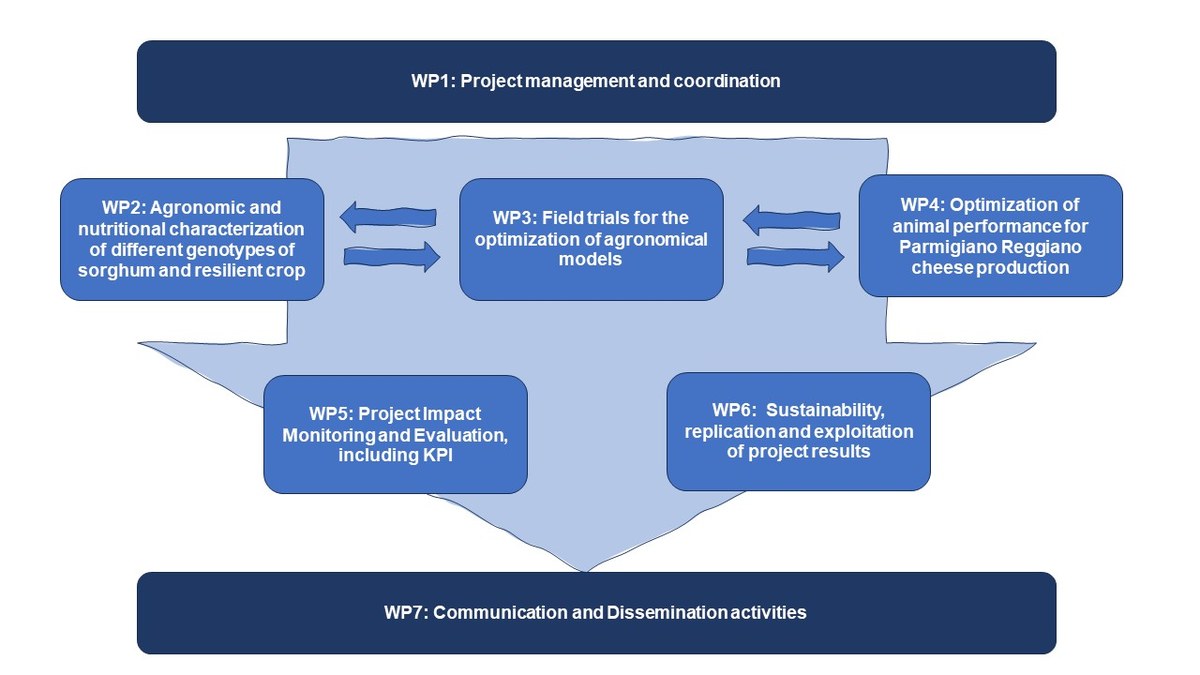
The IMAGE LIFE activities are organized in 7 work packages (WPs): WP1 dedicated to the management and coordination of the project; WPs 2, 3 and 4 in which the technical core of the project will be developed; WP5 dedicated to the impact monitoring, key performance indicators (KPI) settings, and LCA assessment; WP6 in which the sustainability, replication, and exploitation will be evaluated and realized; and WP7 for the communication and dissemination activities.
Specifically:
- WP2 is devoted to expanding resilient genetic resources. This will be accomplished by identifying from among the different genotypes, the best ones in responding to agronomic performances and feed requirements in order to identify useful genetic material for the preparation of tomorrow's varieties;
- WP3 is dedicated to the field trials at farm scale, where sorghum and resilient crops will be cultivated through the adoption of rational rotation schemes and new sustainable approach. Specific guidelines for the resilient cultivation of alternative crops will be elaborated from these trials results and the grain products obtained willbe employed in following WP4 and WP6.
- WP4 aims to define and set up optimized dietary rations with alternative crops (sorghum, wheat, millet and sunflower), considering the animal response and the milk cheese making properties and production. Results will be used to transfer the innovation to the Parmigiano Reggiano supply chain.
- WP5 is devoted towards monitoring the IMAGE LIFE value chain and product sustainability performance from both the environmental and social point of view. A specific LCA will analyse the environmental impacts of the value chain, while a S-LCA will provide an in-depth study of the social and sociological aspects of the products along the long cycle. Moreover, WP5 will monitor and quantify all the Key Performance Indicators along the entire supply chain.
- WP6 will be dedicated to the socio-economical assessment and to demonstrating the replication/exploitation of the IMAGE LIFE system. To this end, replication activities will focus on replacing maize with sorghum in the French regions near Montpellier and Clermont-Ferrand (Auvergne) for the production of the blue-veined PDO cheese Bleu d ’Auvergne or Fourme d’Amber.