Project Outline
The starting point
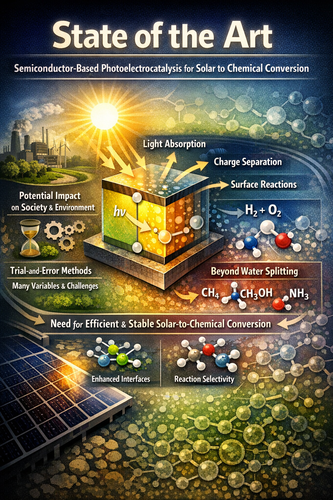
The development of materials for semiconductor-based photoelectrocatalysis has a potentially disruptive impact on the society and the
environment.
However, the choice of an ultimate material and architecture towards efficient PEC solar to chemical conversion devices is
crippled by the time-consuming trial-and-error approach employed in the field, as well as the tremendous number of variables affecting the
performance.
Indeed, beside the need for harvesting of the incoming sunlight, the semiconductor must ensure efficient and stable conversion
of the generated carriers into the desired redox reactions.
This is especially true when investigating reactions beyond conventional water
splitting, where the interfacial properties and the reaction environment are driving chemoselectivity.
The scientific question
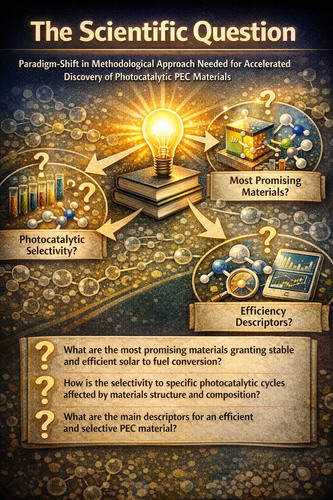
Thus, a paradigm-shift in the methodological approach is required to achieve accelerated discovery of PEC architectures and providing an answer to the following open questions:
- What are the most promising materials granting stable and efficient solar to fuel conversion?
- How is the selectivity to specific photocatalytic cycles affected by materials structure and composition?
- What are the main descriptors for an efficient and selective PEC material?
HERMES approach
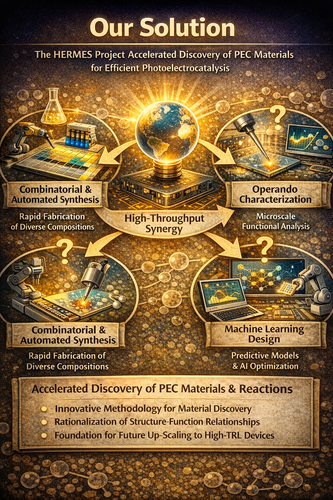
In this framework, the objective of the HERMES project is to establish a set of tools to boost the learning curve for the rationalization of the
materials structure-function relation in photoelectrocatalysis.
To this aim, HERMES proposes an innovative high-throughput synergy between combinatorial synthetic approaches, microscale structural and functional operando characterization, and machine learning predictive design of novel materials for photoelectrocatalysis.
The groundbreaking proposed approach aims at the development of a methodology for the accelerated discovery of PEC materials and chemical reactions, laying the foundation for the future up-scaling to high-TRL devices.