Work Packages
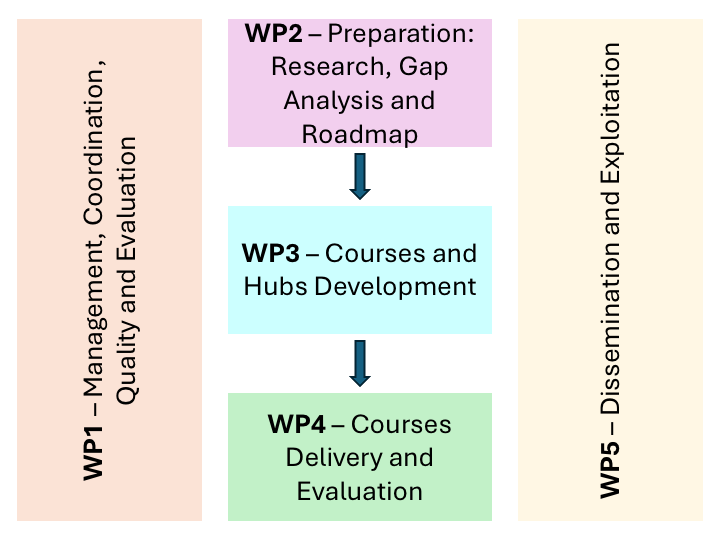
The BRIDGE project is structured into five interconnected Work Packages. Two of them run across the entire duration of the project — WP1 and WP5 — ensuring overall coordination, quality, visibility, and long-term sustainability. At the core of the project, WP2, WP3, and WP4 follow a sequential logic: from needs assessment and planning, to development, to implementation and evaluation of the training programmes.
WP1 – Management, Coordination, Quality and Evaluation
WP1 provides the overall governance framework of the project. It covers project coordination, internal management, quality assurance, risk monitoring, technical and financial reporting, and the functioning of the main governance bodies, including the Management Board and the Quality Assurance Team. Its role is to ensure that BRIDGE is implemented coherently, on time, and in line with its objectives and expected results.
Leader: UNIBO
WP2 – Preparation: Research, Gap Analysis and Roadmap
WP2 lays the foundations for the whole project. It focuses on identifying needs, analysing existing gaps in global health education, reviewing international and regional best practices, and carrying out study visits in European institutions. The final goal of this phase is to produce an updated gap analysis and a shared roadmap that will guide the design of the BRIDGE training activities and institutional development.
Leaders: UNIBO, SFUCHAS
WP3 – Courses and Hubs Development
WP3 translates the preparatory work into concrete structures and educational tools. It includes staff training workshops, co-development of the BRIDGE training modules, development of the MOOC environment, establishment of the two BRIDGE Hubs in Ifakara and Dar es Salaam, and creation of hybrid learning classrooms. This Work Package is central to building the academic and operational capacity needed for the project’s implementation.
Leaders: NKUA, KU
WP4 – Courses Delivery and Evaluation
WP4 is the implementation phase of the project. It focuses on the delivery of the two main BRIDGE training programmes: the blended-learning CPD/CME course for healthcare professionals and the Summer School in Global Health for students. It also includes operation of the MOOC, monitoring of participation and learning outcomes, collection of feedback, and final review of the courses in order to support improvement and future replication.
Leaders: UNIBO, TTCIH
WP5 – Dissemination and Exploitation
WP5 ensures that BRIDGE generates visibility, outreach, and long-term impact beyond the immediate project activities. It covers the dissemination and exploitation strategy, development of the website and communication tools, organization of dissemination events, engagement with stakeholders and local communities, and preparation of the sustainability plan. Its purpose is to maximize the project’s visibility, strengthen synergies, and support the continuation and uptake of BRIDGE results over time.
Leaders: NKUA, KU, SFUCHAS