RESULTS
WP1: Project Management
The experiments were planned jointly by the two Research Units, sharing the experimental design and the results obtained (Task 1.1).
WP2: Optimization of “green” extraction procedures for the recovery of bioactive compounds from red apple pomace.
Objective: to select the best operating conditions in terms of solvents and extraction techniques that allow for the optimal recovery of bioactive compounds (anthocyanins and related phenolic compounds) from red apple peel.
The first phase of the project involved the Research Unit 1 group. In this phase, experiments were conducted to select the best solvent and “green” technique in terms of extraction efficiency of the functional bioactive compounds present in red apple pomace. For this first phase, pomace from the company VOG Products Soc. Agricola coop. in Laives (Bolzano).
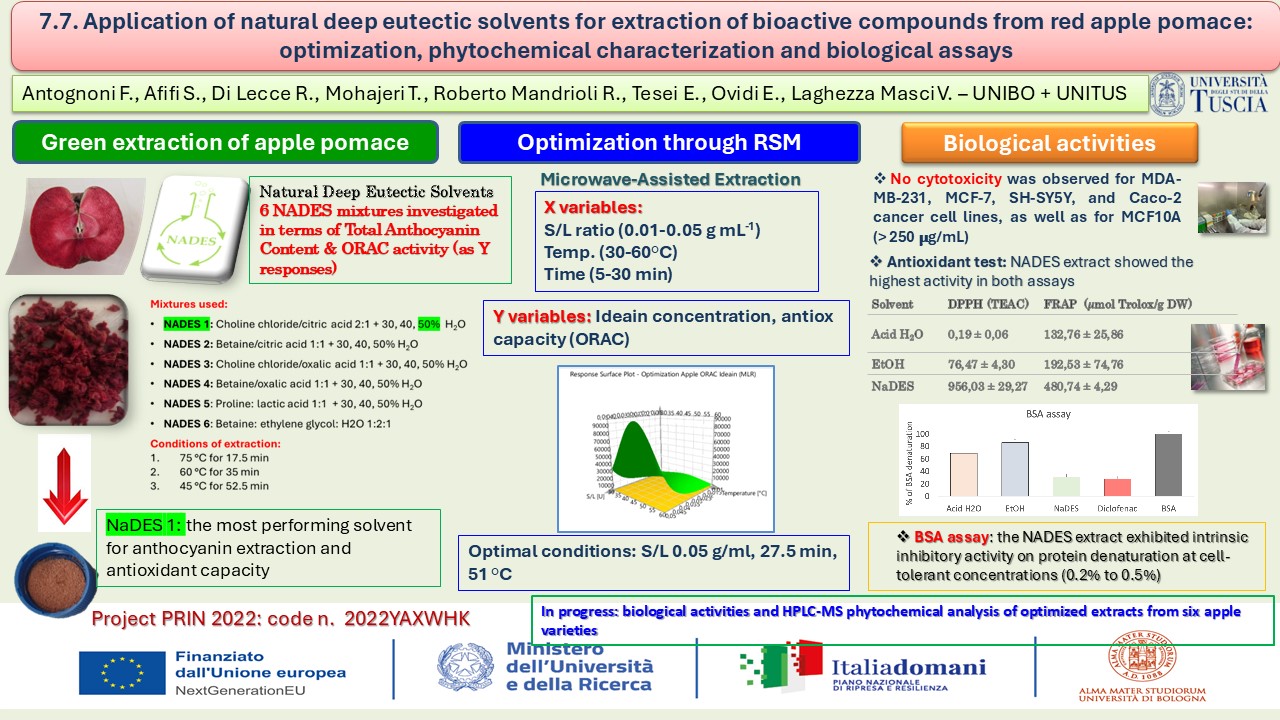
Six different NaDES mixtures were prepared, with different ratios between proton acceptors and donors and different percentages of water, with the aim of selecting the most suitable mixture for apple pomace, a matrix consisting of peel, seeds, and pulp residues from the fruit, and as such very rich in pectic substances. At the same time, two different extraction techniques were compared, microwave-assisted extraction (MAE) and microwave-assisted extraction (MAE) UAE), and the responses were evaluated in terms of total anthocyanin concentration (TAC) and in vitro antioxidant capacity using the ORAC (Oxygen Radical Absorption Capacity) assay. The results allowed the selection of the mixture composed of choline chloride and citric acid in a 2:1 ratio with 50% water as the best solvent, and MAE as the best technique (Task 2.1).
With the solvent mixture and technique selected, the extraction conditions were optimized using a statistical approach called Response Surface Methodology, which allows the combined effect of different variables on the response under examination to be evaluated.
The independent variables chosen were the matrix/solvent ratio (in the range 0.01-0.05 g/ml), time (5-30 minutes), and extraction temperature (30-60°C) were chosen as independent variables, and the concentration of idein (cyanidin-3-O-galactoside) and the antioxidant capacity of the extract, evaluated with the ORAC assay (Task 2.2), were chosen as dependent variables.
To maximize anthocyanin extraction, the values corresponding to the response in terms of idein concentration were analyzed using a quadratic model (Fig. 1). The model was significant (p<0.05), with R2 values of 0.98, Q2 values of 0.97, model validity of 0.93, and reproducibility of 0.98. The model resulting from the analysis of the values corresponding to the response obtained from the ORAC assay (Fig. 2) was also significant (p<0.05), with R2 values of 0.96, Q2 values of 0.89, model validity of 0.87, and reproducibility of 0.94. The optimal conditions were as follows: matrix/solvent ratio 0.05 g/ml, 27.5 minutes of extraction at 51°C. The concentration of ideain predicted by the model was 2.72 mg/g PS, and the antioxidant activity was 12.33 umol/ml.
The experimental values obtained by applying the optimal extraction conditions yielded idein concentration and antioxidant power values within 95% of the model's predictive range (Task 2.3). The optimal conditions were then applied to different pomace obtained from different varieties of red apples, and the extracts were tested for biological activity.
Both Research Units worked together to disseminate the project results. A student enrolled in the Pharmacy Course at the University of Bologna is working on the project, supported by Dr. Sherif Afifi and Dr. Roberta di Lecce, research fellows specifically recruited for the project as staff members.
The results of the first year of the project were presented in poster form at the 120th Congress of the Italian Botanical Society (XI Plant Science Conference), held in Gorizia from September 3 to 6, 2025 (see Figure 1).
Album