Collect water plasma cross-section data and generate an open-access database
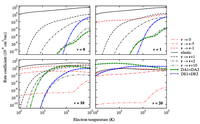
The literature reveals a significant gap in the availability of comprehensive sets of cross sections and rate coefficients for elementary processes occurring in water-based plasmas, both in volume and on the surface. Bridging this gap is paramount for a thorough comprehension of the underlying physics and for accurately assessing plasma dynamics through numerical methodologies. Specifically, in the context of a system containing water, essential chemical species to consider encompass H2O, O2, H2, OH, whereas the chemical reactions span from excitation (both vibrational and electronic), dissociation (including attachment), and ionization. Within the project scope, two types of reactions will be examined by means theoretical models: (i) electron impact with molecules and (ii) collisions between molecules/atoms and the internal wall of the thruster discharge channel. Furthermore, in the context of nonequilibrium systems, understanding energy exchanges necessitates precise cross sections resolved across internal degrees (electronic, vibrational, and rotational) of atoms and molecules. Quantum mechanical methods will be employed to derive these cross sections, and the resulting data will be made available in open-access databases to facilitate community sharing and foster a deeper understanding of phenomena related to water plasma. As an illustrative example of a comprehensive set of theoretical rate constants, we present in the Figure the case of the D2 molecule colliding with electrons, resolved across vibrational levels and for various processes.
Concerning the elementary surface processes (scattering, adsorption, molecule dissociation and atom recombination), data will be determined by using Molecular Dynamics (MD) simulations. These simulations are based on a state-to-state semiclassical collisional method, that explicitly includes the interaction with the surface phonons of different dielectric materials used for discharge channel thrusters. The collisional database resulting from MD simulations includes: probability for a given surface process, state-to-state and global recombination coefficient, roto-vibrational distributions in the final states, state-to-state vibrational accommodation coefficients, and state-selected sticking probability.
